Fishin' Frenzy: The Maths Behind the Bobbing Fisherman
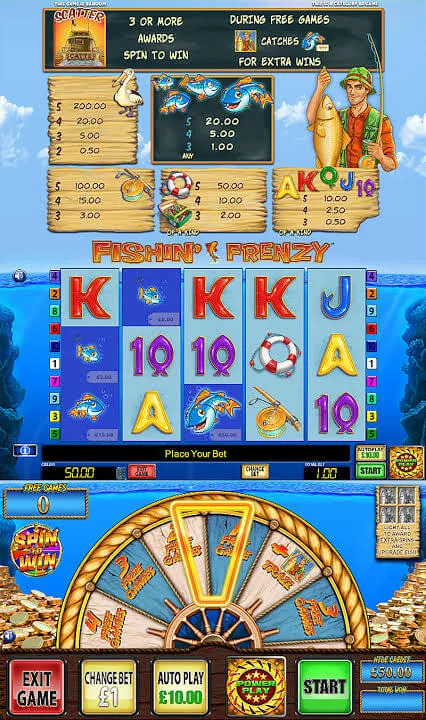
You can drop £10 into Fishin' Frenzy and watch it vanish in ninety seconds, or you can spend the same tenner and trigger three free-spins rounds. Same game, same RTP, wildly different afternoons. That variance is the entire point—Blueprint built a low-stakes slot that swings hard enough to feel like something might happen, without the session-killing volatility of a max-exposure Megaways grid.
This breakdown walks through the mechanics, the money, and the mobile experience. You'll see how the free-spins feature pays, what £20 actually buys you in base-game spins, where the bankroll leaks, and why this particular fisherman has hooked enough UK players to spawn half a dozen sequels.
How a round works: ten lines, one fisherman, and a conditional multiplier
Fishin' Frenzy runs on a 5×3 grid with ten fixed paylines. You pick a stake—say £1.00—and the game divides that across the lines. Land three matching symbols left-to-right on any line and you collect the paytop multiple of your total stake, not per line.
The fisherman is wild and substitutes for everything except the scatter. In the base game he does nothing else; he's just a stand-in. The real mechanic kicks in during free spins: any fish symbol landing on the same spin as a fisherman wild is collected at the value printed on the fish, then paid as a cash prize on top of line wins. Those fish values range from 2× to 50× your stake per fish, and you can land multiple fish in one spin if the wild appears.
Base-game line wins pay modestly: five-of-a-kind top-tier symbols return 50× your stake, mid-tier pays 20–30×, low-tier royals pay 5–15×. The paytable is shallow because the free-spins feature carries the heavy lifting. You're spinning to trigger the scatter, not to build a bankroll from regular line wins.
What £20 buys you: spin count, trigger odds, and the base-game grind
At £1.00 per spin, twenty pounds gives you twenty attempts. Medium volatility means you'll see small wins often enough to stretch that count—perhaps to thirty or forty spins if you catch a few 5–10× line hits—but the maths says you'll trigger free spins roughly once every 100–150 spins on average. That's a wide confidence interval; you might trigger twice in fifty spins or go two hundred dry.
Drop your stake to £0.20 and the same £20 funds a hundred spins, which statistically improves your chance of seeing at least one trigger. Raise it to £2.00 and you're ten spins deep before the bankroll's gone. The stake cap is £5.00 for over-25s, £2.00 if you're 18–24, so your maximum exposure per spin is already legislated.
| Stake per spin | Spins from £20 | Rough trigger probability |
|---|---|---|
| £0.10 | ~200 spins | High chance of 1–2 triggers |
| £0.50 | ~40 spins | Coinflip territory |
| £1.00 | ~20 spins | Long odds on a single trigger |
| £2.00 | ~10 spins | Mostly chasing line wins |
| £5.00 | ~4 spins | Lottery-ticket session |
The 96.12% RTP is theoretical over millions of spins. In a fifty-spin session you might see 80% returned or 110%; short-term results are noise. The game doesn't owe you a trigger, and the RNG doesn't remember your last session.
Free spins and fish collection: where the multiplier actually lives
Three scatters award ten free spins. During those spins, every fish symbol that lands on a reel with a fisherman wild is collected at face value—2×, 5×, 10×, 20×, or 50× your stake—and paid immediately. You can collect multiple fish in one spin if the wild appears on a reel with several fish, or if wilds land on multiple reels.
A strong free-spins round might collect 100–200× your stake across all ten spins; an exceptional round with multiple wilds and high-value fish can push 500× or more. The 20,000× max win exists in theory—land max fish values on every spin with optimal wild placement—but it's vanishingly rare. Most triggers return 20–80× your stake, enough to recover some base-game losses or fund another few dozen spins.
The base game feels flat by design. You're waiting for the feature, and Blueprint tuned the line wins to drip-feed small returns without giving you much headroom. Medium volatility means you won't haemorrhage your stake instantly, but you also won't claw back meaningful ground without a scatter hit.
Step-by-step: setting up, spinning, and knowing when to stop
- Log in to a UKGC-licensed site—check the footer for the licence number and look it up in the Commission's public register. Unlicensed operators are illegal to use here and won't pay out if you win.
- Load Fishin' Frenzy in demo mode first if the site allows it. Many operators gate free play behind account registration and age verification, so you may need to create an account and upload ID before testing.
- Choose your stake using the coin-value selector. The game shows total stake per spin, not per line. Confirm your balance can cover at least 50–100 spins at that level; anything less and you're flipping coins.
- Decide between manual spins and autoplay. Autoplay lets you set a spin count and loss/win limits, which is useful for testing volatility or managing a session budget. Manual play gives you control to stop mid-streak.
- Spin and watch for three scatters. Base-game wins are usually small; you're building toward the feature trigger. If you hit free spins, the game switches to the collection mechanic automatically—no input needed.
- During free spins, fish symbols are collected when a wild lands on the same reel. The total collected value appears in the feature counter and pays at the end of the round, on top of any line wins.
- After the feature ends, check your balance against your starting point. If you're ahead, decide whether to bank it or keep playing. If you're down, decide whether the next trigger is worth the cost of getting there.
- Set a stop-loss before you start and stick to it. The RTP is 96.12%, which means the house edge is 3.88%—you will lose money on average over time, and one good feature doesn't change that maths.
Mobile, demo, and where to play for real money
Fishin' Frenzy runs in-browser on iOS and Android via HTML5. No app required; open the site in Safari or Chrome, log in, and launch the game. The grid scales to fit portrait or landscape, though landscape gives you more screen real estate for the paytable and balance info. Load times are quick on 4G or Wi-Fi, and the game pauses automatically if you switch apps or lock the screen.
Touch controls are straightforward: tap the spin button, swipe to adjust stake, tap the menu icon for autoplay and settings. The interface is the same as desktop, just compacted. Blueprint didn't build a separate mobile version; it's one codebase optimised for all screen sizes.
Demo mode is available on most UKGC-licensed sites, but many now require you to log in and verify your age before showing free play. This is a regulatory push to prevent under-18s accessing gambling content, even in demo form. If a site offers instant demo with no login, check it's actually licensed—unlicensed operators often use free play as a lead-in and vanish when you try to withdraw.
For real-money play, you need a UKGC-licensed operator, a UK bank account or payment method in your own name, and ID documents ready for verification. Credit cards are banned; debit cards, PayPal, Apple Pay, and Open Banking are standard. First withdrawals take 24–48 hours while the operator checks your documents; after that, e-wallet payouts usually clear within a few hours, and Faster Payments to your bank arrive same-day or next working day.
How this compares to Megaways and the half-dozen sequels Blueprint released
Fishin' Frenzy launched in 2014 and became Blueprint's most-cloned internal IP. There's Fishin' Frenzy Megaways, The Big Catch, Prize Lines, Even Bigger Catch, and Jackpot King versions, each tweaking the mechanic: more reels, cascading wins, progressive pots. The original remains the simplest and the lowest-variance entry point.
- Megaways adds up to 117,649 ways to win and higher volatility, which means longer dry spells and bigger feature potential. Max win jumps to 10,000× in some versions, but so does the cost of reaching it.
- Prize Lines overlays a fixed-multiplier ladder on the reels; collect fish to climb the ladder during free spins. It's more structured but less swingy than the original's open-ended collection.
- Jackpot King bolts a progressive-pot mechanic onto the base game. You can trigger a pick-em bonus that awards one of five jackpots, the largest seeded at five figures. Variance is higher because the RTP is split between the base game and the jackpot contribution.
- The Big Catch and Even Bigger Catch increase max fish values and add more wilds during free spins, which amps up the ceiling but doesn't change the fundamental loop.
The original Fishin' Frenzy sits in the middle: enough volatility to deliver memorable features without the session-killing swings of a high-variance Megaways grid. If you want frequent small features, this is the better pick. If you want to chase four-figure multipliers and can stomach two hundred dead spins, go Megaways.
Blueprint saturated its own niche here. Every sequel is mechanically competent, but none redefined the formula—they just repackaged it. The original still gets traffic because it's the known quantity, and because operators feature it prominently in lobbies and promos. That ubiquity is both a strength and a ceiling; everyone knows what they're getting, which means there's little discovery left.
FAQ
Can I play Fishin' Frenzy for free without signing up?
Most UKGC-licensed sites now require you to create an account and verify your age before showing demo mode, even for free play. This is a regulatory measure to prevent under-18s accessing gambling content. If a site offers instant demo with no login, check it holds a valid UKGC licence—unlicensed operators often skip age checks and won't pay out if you win.
What's the difference between the original and the Megaways version?
The Megaways version adds up to 117,649 ways to win, cascading reels, and higher volatility. Max win potential is higher—some versions reach 10,000× stake—but so is the cost of triggering features, and you'll see longer losing streaks. The original Fishin' Frenzy has ten fixed paylines, medium volatility, and more frequent but smaller features. If you want steadier play, stick to the original; if you're chasing big multipliers and can handle dry spells, try Megaways.
How often do free spins actually trigger, and what do they usually pay?
Statistically, free spins trigger roughly once every 100–150 spins, though variance means you might see two triggers in fifty spins or none in three hundred. Most features return 20–80× your stake; strong rounds with multiple wilds and high-value fish can push 200–500×. The 20,000× max win is theoretical—it requires perfect fish placement and optimal wilds across all ten spins, which is vanishingly rare in practice.
Are there any strategies to improve my chances or make the RTP work in my favour?
No. Fishin' Frenzy uses a certified RNG; every spin is independent, and the game doesn't remember your session history. The 96.12% RTP is a long-term average over millions of spins, not a guarantee for your fifty-spin session. Lowering your stake stretches your bankroll and gives you more shots at triggering features, but it doesn't change the maths. Set a loss limit before you start, stick to it, and accept that the house edge is 3.88%—you will lose money on average over time.